

Smoke Grey WPC exterior wall cladding in a warm greige
A greige rather than a cold grey — the tone that lets composite cladding sit next to concrete and render without arguing with them.
- Value
- Mid to dark
- Colour temperature
- Warm grey
- Profiles
- 178 × 15 / 223 × 25 mm
- Warranty
- 10 years
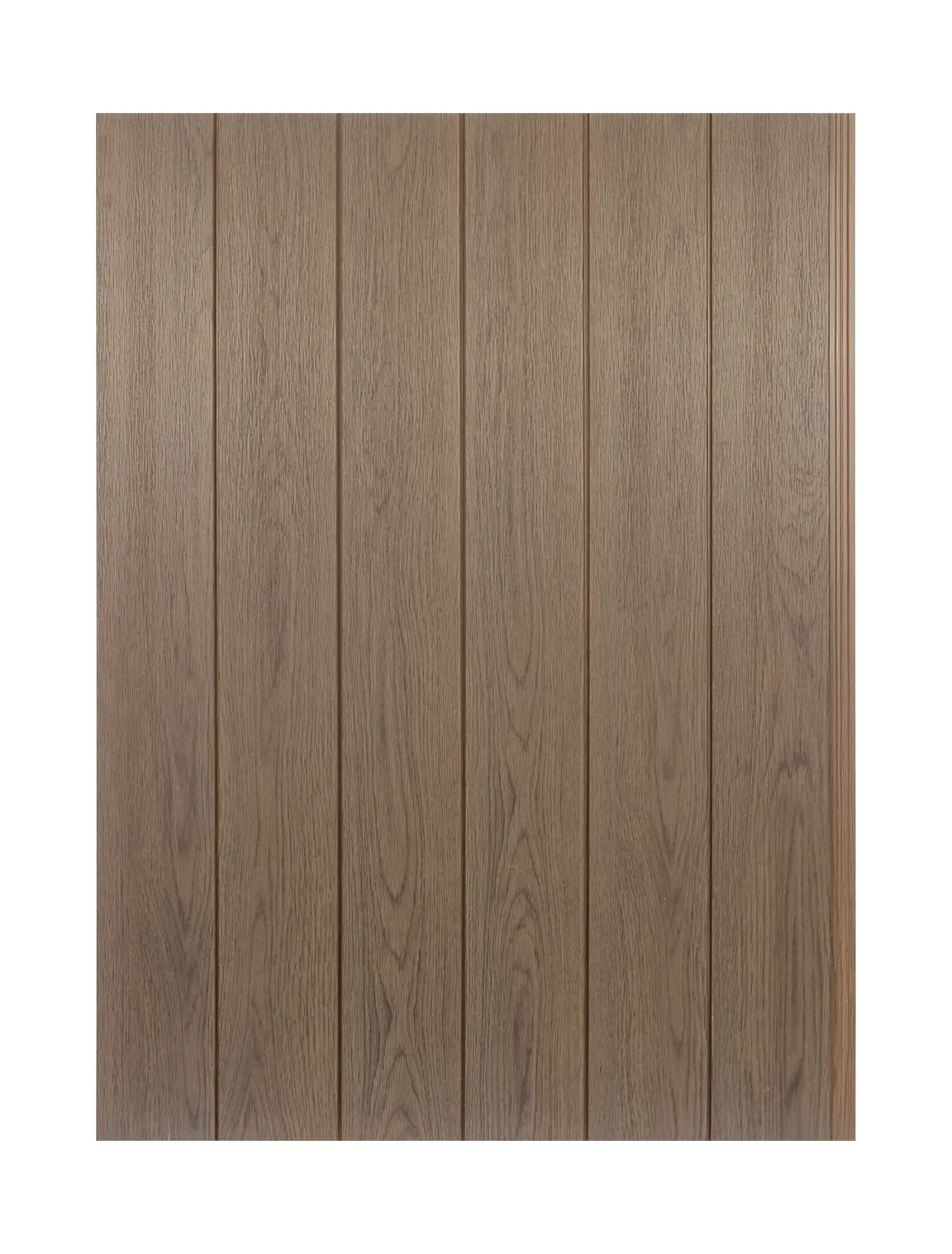
Photographs of the actual boards in this colour. Tap any swatch to move through the range.
Where Smoke Grey sits in the six.
| Colour | Value | Temperature |
|---|---|---|
 Pale Oak Pale Oak | Lightest | Cool neutral |
 Ash Silver Ash Silver | Light to mid | Cool grey |
 Golden Beech Golden Beech | Light to mid | Warm golden |
 Honey Teak Honey Teak | Mid | Warm honey |
 Smoke Grey ← you are here Smoke Grey ← you are here | Mid to dark | Warm grey |
 Coffee Walnut Coffee Walnut | Darkest | Warm dark |
Three distances, three different colours.
The same board reads differently at arm's length, in the hand and from across the street. Look at all three before you decide — most disappointments with a timber-effect facade come from judging only one of them.
The surface you touch
A warm grey with a visible brown undertone and a trace of the grain figure still showing through. It is not a flat architectural grey; there is enough warmth in it that it reads as stained timber from a few metres away.
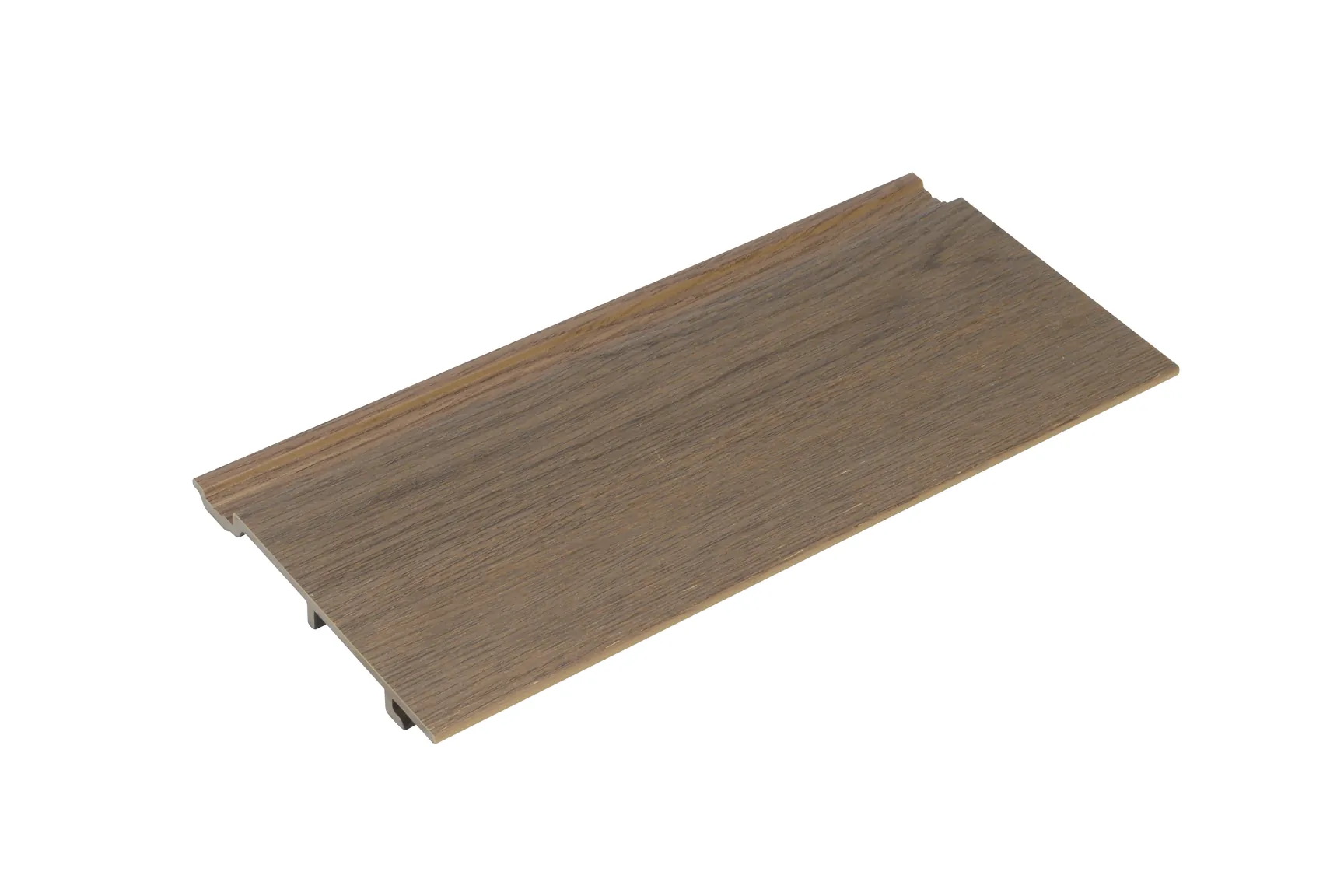
The board in your hand
A single Smoke Grey board against the light. There is still grain figure in it: the pore lines run a shade darker and browner than the ground. It is not a flat architectural grey with the texture sanded off, and from a few metres the warmth in the undertone is what makes it read as stained timber.
The wall at twenty metres
The same boards installed. At this distance it blocks as a mid-dark field with a fine board rhythm. It keeps enough depth to make a shadow line under an eave visible, which is the thing the lighter tones most often lose.
How Smoke Grey behaves as the light changes.
The mid-dark tones are the stablest in the range and this one is the stablest of them: it gains warmth in sun and cools toward neutral under cloud, but it holds its value because it starts darker than the other grey.
At arm's length
A warm grey with a visible brown undertone and a trace of the grain figure still showing through. It is not a flat architectural grey; there is enough warmth in it that it reads as stained timber from a few metres away.
As the light moves
It gains warmth in sun and cools toward neutral under cloud, but it holds its value better than Ash Silver because it starts darker. It is the tone that most reliably matches grey concrete, fibre cement and render without the joint between the materials becoming a colour event.
At twenty metres
At twenty metres it reads as a mid-dark field with a fine board rhythm. It has enough depth to make a shadow line under an eave visible, which the lighter tones often lose.

Six real sections, one lighting setup — the only honest way to compare two tones.
Horizontal or vertical
The grain runs along the board, so rotating the layout through 90 degrees rotates the figure with it, and changes the elevation more than the colour does. Horizontal boards make an elevation read wider and lower; vertical boards make it read taller. Decide it before the lengths are ordered.
In depth: Smoke Grey.
Cladding beside concrete and render - how to avoid a colour event
The problem with grey cladding next to concrete is rarely that the two are different. It is that they are similar enough to be compared. Two greys that sit side by side and fail to resolve into either a match or a contrast is what makes a joint between materials into something you notice, and that is what this tone is designed around: Smoke Grey is a warm grey with a visible brown undertone, and board-formed concrete is a cool grey. The undertones are opposite, so the two read as one material family without pretending to be the same material.
If the intent is the opposite - if you want the cladding to disappear into the concrete rather than sit beside it - then take Ash Silver instead, which is cooler and closer in value. Either way, look at the two surfaces together outdoors under cloud before the render colour is signed off, because that is the condition that exposes the problem.
Dark enough to keep a shadow line, light enough to stay out of the heat argument
The mid-dark tones hold detail that the light ones lose. A shadow line under a generous eave or a deep reveal reads as a line on Smoke Grey and disappears on Pale Oak, which is one of the reasons a mid-dark tone is often chosen for a building with a strong horizontal roofline. It also hides dust and salt spray better than any of the pale tones.
Unlike the darkest tone in the range, it does not bring the solar-absorption argument with it. A dark surface absorbs more solar radiation than a light one - that is physics, not a product property - and in hot markets that is a real consideration when a whole elevation faces the afternoon sun. On this board the ventilated cavity behind the cladding is what decouples the board from the wall, so the heat that reaches the surface leaves with the air movement rather than soaking into the build-up. It is worth putting the cavity detail, not just the colour, into the specification.
Retrofit: adding to a building that is already grey
A large part of the work this tone does is on buildings that are not new. Adding cladding to an existing structure means the new material has to sit against what is already there - existing render, fibre cement, painted blockwork, a neighbouring building's boundary wall - and a warm grey that is close to but not the same as what surrounds it settles into that position better than a colour would. It reads as part of the building rather than as an addition to it.
The same property makes it the quiet choice for boundary walls, fencing and outbuildings, where the wall is structure rather than feature. And where a two-tone scheme is wanted with a light base, Smoke Grey above Pale Oak or Ash Silver below is the combination that needs the least explanation - the light tone does the drawing and the darker one gives the elevation its weight.
Where this tone family is already specified.
Smoke Grey is read here against the grey group in our project file.
| Market | What the project file records |
|---|---|
| AustraliaOceania | Dark grey wall cladding, and SP-WP14 dark grey + IPE wall and deck |
| CanadaNorth America | SP-WP14 black with a custom walnut tone |
| SerbiaEurope | Black wall cladding project set |
How to read that table for Smoke Grey
Smoke Grey sits in the grey group, which is recorded in Australia (dark grey cladding, and dark grey plus IPE on a wall-and-deck project), Canada (SP-WP14 black with a custom walnut tone) and Serbia (a black cladding project set). The pattern worth noticing is that every one of those records is a dark grey rather than a light one, and two of the three are used as the darker half of a two-tone elevation. That is consistent with how the tone behaves: it is specified where a wall needs weight without going to a red-brown, and it is specified next to something lighter.
Every row above is a folder in the project photo file for the MexyTech co-extruded wall system that FV01 and FV02 are engineered on. It is not a claim that these installations used FV01 or FV02. The ledger records the profile and the market, not the pigmentation code, so the rows are grouped by tone family.
Where Smoke Grey is used.
Cladding beside concrete or render
The clearest use. Warm grey against cool concrete reads as one material family.
Commercial and mixed-use facades
Mid-dark enough to give a large elevation weight without the heat and dust issues of a dark brown.
Soffits and deep eaves
Keeps the underside recessive while still reading as a material.
Boundary walls and fencing
Reads as structure rather than as cladding.
Two-tone facades with a light base
Pale Oak or Ash Silver below, Smoke Grey above.
Retrofit onto an existing grey building
Lets the new cladding sit against what is already there.
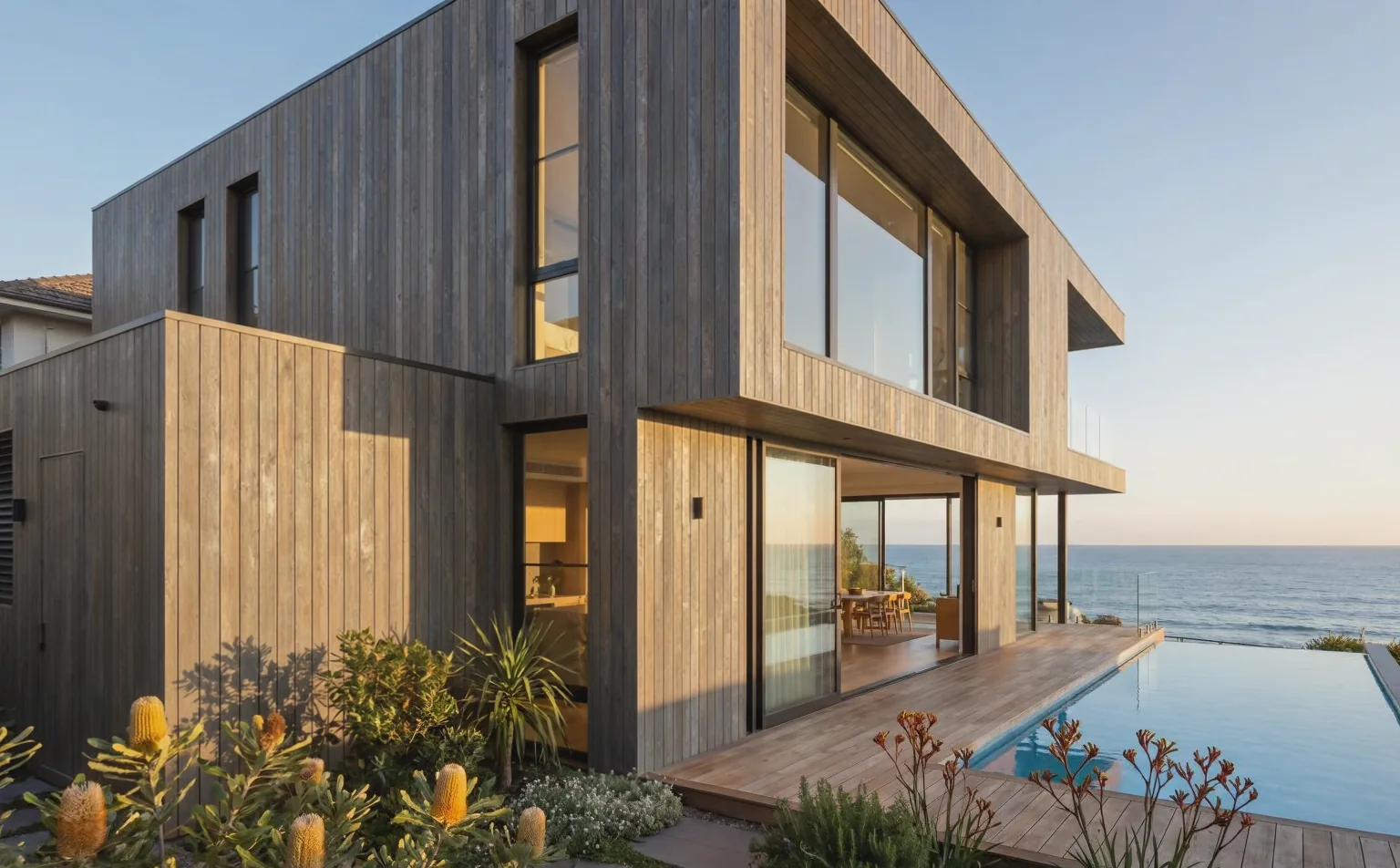
Concept visualisation: the same elevation in a warm mid-dark greige. This is a design impression, not a photograph of an installed FlowVeins project.

The section is the argument: a fourth-generation WPC core, a composite ASA surface cured into it, and an interlocking edge that takes the screw without a visible fixing.
What Smoke Grey sits beside.
Pale Oak for the softest two-tone in the range; Coffee Walnut for a dark-on-dark combination where the difference shows only in raking light. Outside the range: board-formed concrete, white render, black steel, galvanised and zinc sheet.
Specification.
Nothing in the table below changes with the tone, which matters more than usual here: a mid-dark surface is often specified for the cavity detail and the shadow line, and neither of those is a colour decision.
| Profiles | FV01 178 x 15 mm · FV02 223 x 25 mm |
|---|---|
| Exposed face | FV01 150 mm · FV02 195 mm |
| Construction | Fourth-generation WPC core with a composite ASA surface, cured together in the molecular crystal curing stage |
| Fixing | Patented pre-punched male end, screw-fixed to battens |
| Length | 2.9 m standard, custom within 3.0 m |
| Colours | Six standard colours, combinable in one container load |
| Warranty | 10 years, coverage scope subject to the formal warranty statement |
| Chain of custody | FSC® ESTS-COC-240458 |
| Fire | EN 13501-1 B-s3, d0 — tested on a 26 mm specimen, screw-fixed to a substrate, 40 mm ventilated cavity, no joint |
| UV / weathering | 3000 h QUA ageing report for the ASA surface, SDHL2407013318HI |
| Surface reference | The signed physical sample governs production, not any screen image |
Fire classification is quoted with its specimen build-up. FV01 is 15 mm and FV02 is 25 mm, and the classified specimen was 26 mm — confirm the required build-up against your project.


Choosing between two close tones.
Smoke Grey vs Ash Silver
Ash Silver is cooler, lighter and carries a silver sheen. Smoke Grey is warmer, darker and browner. Straight-on they can look similar on a screen; at an angle and in sunlight they separate immediately. This is the pair on which the physical sample matters most.
Smoke Grey vs Coffee Walnut
Smoke Grey is the neutral version of the dark end; Coffee Walnut is the red-brown version. If the facade is next to brick or warm stone, Smoke Grey is the quieter neighbour.
Questions buyers ask about Smoke Grey.
Will the delivered colour match the photo on this page?
No, and no supplier can promise that. Grain direction, the angle of the light and the production batch all shift what the eye reads, and a screen adds its own colour cast. Every colour is supplied as a physical section of the FV01 or FV02 profile you are specifying, and the approved sample is the reference production is held to.
Does it fade or grey off the way timber does?
ASA is chosen for facades because it holds colour under UV. The 3000 h QUA ageing report for the ASA surface is SDHL2407013318HI. Colour retention is projected to exceed 20 years of outdoor exposure — a test-based estimate, not a warranty period. The commercial warranty is issued separately and is shorter by design: 10 years.
Is it fire tested?
EN 13501-1 B-s3, d0 was classified for a 26 mm specimen, screw-fixed to a substrate, with a 40 mm ventilated cavity and no joint between specimens. The classification applies to that specimen build-up; FV01 is 15 mm and FV02 is 25 mm, so use the tested build-up as the reference and confirm the requirement against your project.
What is the minimum order?
Half a container per colour. The six standard colours can be combined within one container load, but each colour ordered has to meet its own minimum.
Will it clash with concrete?
Warm grey beside cool grey concrete is a deliberate tonal pairing, and it works because the undertones are opposite: the concrete reads cool, the cladding reads warm. If you want the cladding to disappear into the concrete rather than sit beside it, Ash Silver is the closer match.
How is it different from Ash Silver?
Ash Silver is the lighter, cooler, more metallic of the two; Smoke Grey is a deeper, warmer greige with more brown in it. Put in value order across the six, Ash Silver comes second and Smoke Grey fifth.
Put Smoke Grey in your hand before you specify it.
The most useful thing to send with a sample request is the neighbouring material - a photograph of the concrete, the render or the existing wall this elevation has to sit against. The sample we cut is from production board, not a colour chip.
- MOQ
- Half a container per colour
- Lead time
- 30 days after order confirmation, standard colours
- Combining
- All six can share one container load

Samples are cut from production board, not cast as colour chips — so the grain, the sheen and the edge you hold are the ones you will receive.