

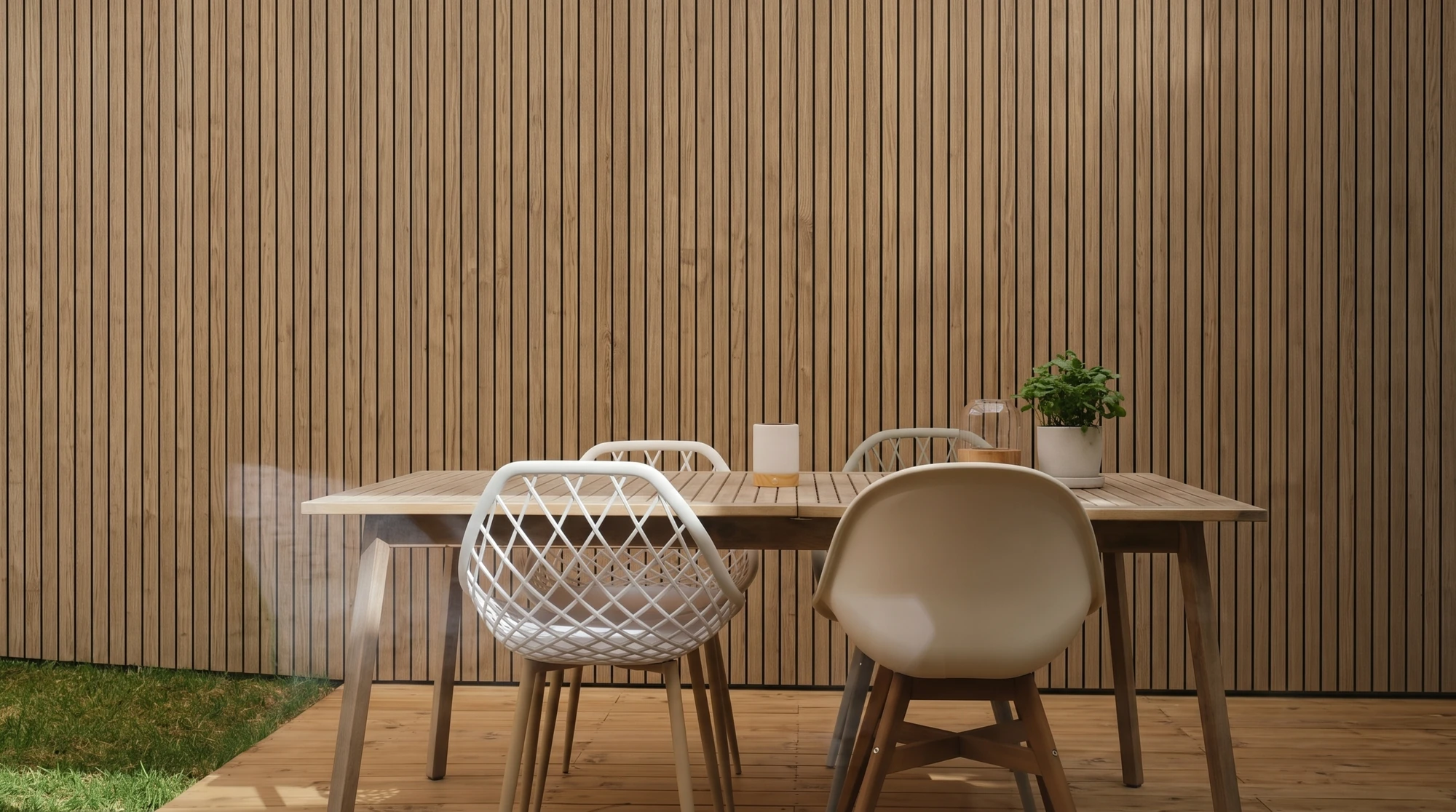
Walk into a European building-materials store and the wall panels are all in the same run of shelving: interior slat panels, acoustic panels, wet-zone panels for bathrooms, and exterior cladding. They look related. Only one of them belongs on a facade, and the labels on the shelf say so if you read them.
Interior panels and outdoor cladding are different products
The wall panels sold for indoor use are built to be seen and handled indoors. Exterior cladding is built to survive weather it cannot be sheltered from. The gap between them is not marketing, it is the test programme behind the board.
What the label on an interior panel says
In Spanish building-material stores our field teams recorded interior wall panels carrying one of two phrases: para zonas secas, for dry zones, and para zonas húmedas, for wet zones such as bathrooms. Neither label claims exterior use. A bathroom wall and a facade are different environments, and the panel suppliers know it.
The wet-zone panels are typically sold in packs of about 2.6 m² with a slat width around 16.7 cm and a 12 mm thickness, and the store also sells an installation service alongside them. Interior slat panels are commonly MDF or a thin composite skin over a soft core. That construction is fine for a dry living-room wall and unsuitable for a facade.
Four exposures an interior panel was never tested for
- Ultraviolet light, all day, both sides. An interior panel sits in a room. A facade board takes direct sun on one face and reflected light and heat from the ground, from water and from glazing. Colour stability has to be measured, not assumed.
- Liquid water, driven sideways. Indoor humidity is vapour. Rain arrives as liquid under wind pressure and finds every unsealed joint and edge. A panel sold for dry zones has no drainage or sealing concept at all.
- Freeze-thaw cycling. Water that enters a material and then freezes expands, and after enough cycles it cracks the surface open. This test only matters outdoors, which is why interior panels do not carry it.
- Reaction to fire in a facade assembly. Interior decoration and an external wall are regulated differently, and the classification has to match the way the board is fixed to the wall.
What outdoor rated has to mean for a wall panel
A supplier claiming outdoor suitability should be able to produce third-party results for each of these, with a report number you can request. This is what FlowVeins publishes:
| Property | Test method | FlowVeins result | Report |
|---|---|---|---|
| UV ageing, 3,000 h | ASTM G154 | ΔE*ab 2.7, grey scale 4 | SDHL2407013318HI |
| Water absorption, 24 h soak | ASTM D1037 | 1.8% absorption, 0% thickness swell | SDHL2408014917HI |
| Flexural strength after freeze-thaw | ASTM D7031 | 28.3 MPa | SDHL250601030601HI |
| Reaction to fire | EN 13501-1:2018 | B-s3, d0 on a 26 mm specimen | SDHL250200203201HI |
The UV figure is the one to read carefully: a colour change of ΔE*ab 2.7 after 3,000 hours of accelerated weathering is a small shift, which is the point of an ASA surface. The wood fibre in the core is FSC chain-of-custody certified, certificate ESTS-COC-240458.
Why the surface layer decides whether a board belongs outside
An interior panel and an exterior board can share the same kind of core and still behave nothing alike, because weather never reaches the core. It reaches whatever is on the outside of it. That is why “outdoor” is a statement about the surface before it is a statement about the section.
Interior slat panels are finished with a printed film, a paper overlay or a veneer over a soft core, and the organic material in that surface is left exposed. The failure that follows is not mechanical, it is chemical. Ultraviolet light and water break down the lignin in exposed wood fibre, the fibre releases at the surface, and the panel goes grey, then chalky, then rough to the touch. A board built that way is not defective outdoors. It was never asked the question.
Exterior composite cladding has moved through four generations, and each one changed what the surface can do:
| Generation | What it is | What it still could not do |
|---|---|---|
| First | Plain WPC: wood fibre and polymer mixed and extruded as one material | Wood fibre sat exposed at the surface, so the board faded and chalked |
| Second | Co-extruded WPC: a plastic outer layer extruded over the core | The surface took the weather, but the grain still came from a single mould |
| Third | A conventional ASA outer layer | Colour retention improved, the grain was still a repeat pattern |
| Fourth | FlowVeins molecular crystal curing | The grain and the ASA surface are set together, so the pattern does not repeat and the board holds its shape and its colour |
The grain is what a visitor sees from the pavement, and it is where the first three generations all stop short. A pressed pattern is one pattern: the same grain runs board after board, and on a long elevation the eye starts to find the rhythm. FlowVeins carries the brushed texture, a deep grain formed in the ASA surface, and it does not repeat the way a single mould does. FlowVeins puts the appearance at 99% of a timber board, and the grain is what carries that rather than the colour.
Three properties follow from the construction, and an exterior wall needs all three:
- The grain reads as timber and does not repeat. This is the difference a client sees at handover, and the one thing a colour card cannot show.
- The board does not distort. A WPC core sealed inside an ASA surface takes up almost no water, so the panel does not swell, cup or bow as the weather changes. After 24 hours of total immersion it records 1.8% water absorption with 0% thickness swelling (ASTM D1037, report SDHL2408014917HI).
- The colour does not fade out. Under 3,000 hours of accelerated UV ageing the shift is ΔE*ab 2.7 on a grey scale of 4 (ASTM G154, report SDHL2407013318HI). There is no repainting cycle anywhere in the life of the wall.
Taken together, those three are the reason the fourth generation is the one built for exterior walls: a surface that reads as timber, holds its shape and keeps its colour, in a profile that is fixed like a rainscreen board. The board is a fourth-generation WPC core under a composite ASA surface, acrylonitrile styrene acrylate. The formulation is published, because a specifier cannot judge a facade material from a colour chip: 50% PVC, 25% wood fibre or plant fibre, 15% calcium carbonate filler and 10% additives.
The two FlowVeins profiles for outdoor walls
FlowVeins makes two sections. Both are composite wood, both carry an ASA cap, and they are chosen by how the wall is fixed rather than by appearance:
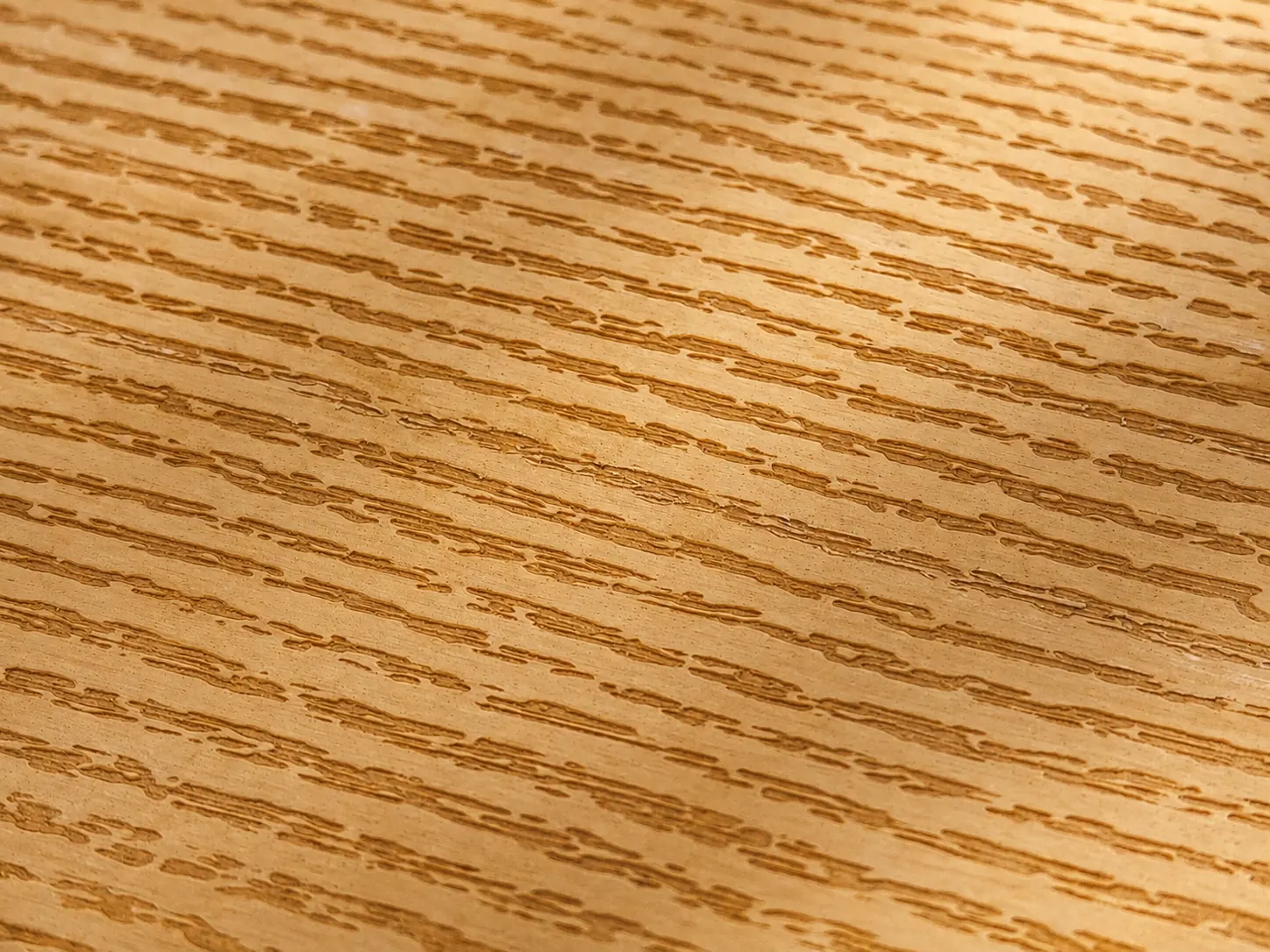
FV01, the flat panel
FV01 is 178 × 15 mm with a 150 mm exposed face once the joint is closed. Four internal chambers, a 7.41 mm locking tongue. Choose it on elevations where the wall should read as one continuous surface and the fixing must disappear.
FV02, the slat-wall profile
FV02 is 223 × 25 mm with a 195 mm exposed face and three 47.61 mm slats separated by 18.51 mm open gaps. The deeper section spans further between supports, and the open gaps read as a shadow line rather than a printed pattern. Both profiles are supplied in 2.9 m lengths, with custom lengths on request, in the six standard colours.
How many boards a square metre actually needs
Board count is where facade budgets are lost, so run the arithmetic before ordering. The figure that matters is the exposed face, not the overall width, because the joint is hidden:
- FV01: 0.150 m exposed × 2.9 m length = 0.435 m² per board, so 2.30 boards per square metre, or about 230 boards per 100 m².
- FV02: 0.195 m exposed × 2.9 m length = 0.5655 m² per board, so 1.77 boards per square metre, or about 177 boards per 100 m².
Add 5 to 10 percent for cutting waste, corners, window reveals and openings, and more if the elevation is broken up by many service penetrations. Ordering on overall width instead of exposed face overstates the coverage by roughly 15 percent on FV01, which is the kind of error that shows up as a short delivery in the middle of an installation.

Fixing: what the wall has to provide
A cladding board is fixed through pre-punched holes to joists at 300 to 400 mm centres, with hidden clips and screws. The pre-punched positions set the expansion allowance, and the interlocking edge hides the fixing line, so the wall reads as continuous even on a long elevation.

This is a rainscreen system: the cladding is the outer skin, and the cavity, flashing and weather-resistive barrier behind it keep the wall dry. If a supplier describes their board as the waterproofing, the detail behind it is missing.
When outdoor WPC cladding is the wrong choice
- A wall that has to be non-combustible. FlowVeins is EN 13501-1 B-s3, d0, which is combustible with limited smoke production and no flaming droplets. Non-combustible requirements rule it out, and the building class should be checked first.
- A buyer shopping on the lowest line of a tender. Interior-grade composite and thin imported panels cost less and are sold for exactly that purpose.
- An elevation where nobody will drain the cavity. Any rainscreen board fails if the wall behind it cannot dry.
Frequently asked questions
What is a fourth-generation WPC cladding board?
The fourth generation of composite cladding is the one where molecular crystal curing sets the grain and the ASA surface together. The three generations before it all pressed the grain from a single mould, so the pattern repeated board after board. The fourth generation is the one specified for exterior walls because the surface reads as timber, the panel does not distort, and the colour does not fade out.
Can I use an interior wall panel outdoors?
Not for a surface that takes rain and sun. Interior panels are labelled for dry or wet indoor zones and carry none of the exterior test data. On a covered porch they may survive for a while, which is exactly what makes the mistake expensive: it fails later rather than on day one.
Is composite wall cladding waterproof?
The board itself takes up very little water. Our own 24-hour immersion test records 1.8% absorption with no thickness swelling, because the ASA cap keeps the wood fibre core sealed. That is not the same as a wall being waterproof: the cavity, flashing and weather barrier do that job.
Does the colour fade?
Every exterior material shifts a little under UV. The measurable question is how much. After 3,000 hours of ASTM G154 accelerated weathering the FlowVeins cap measured ΔE*ab 2.7 with a grey scale reading of 4.
How do I know a supplier’s exterior claim is real?
Ask for the report number of the UV test, the water absorption test and the fire classification, and for the end-use conditions on the fire report. A supplier who has run those tests will send them.
What is the minimum order?
Half a container per profile and colour, with colours combinable in one load. Terms are FOB Shenzhen, and pricing is quoted per project from the elevation area and target port.
Which profile should I choose?
FV01 where the wall should read flat and continuous, FV02 where a deeper shadow line and wider joist spacing help. The exposed faces are 150 mm and 195 mm, so the coverage difference is about 30 percent per board.
Specification summary
- Profiles: FV01 flat, 178 × 15 mm, 150 mm exposed face; FV02 slat-wall, 223 × 25 mm, 195 mm exposed face
- Length: 2.9 m standard, custom lengths on request
- Colours: Pale Oak, Ash Silver, Golden Beech, Honey Teak, Smoke Grey, Coffee Walnut
- Fixing: hidden clips and screws, joists at 300 to 400 mm centres
- Certificates: FSC ESTS-COC-240458; four SGS reports as listed above
- Terms: FOB Shenzhen, half a container per profile and colour
Full profile drawings and system details are on the exterior wall cladding page. For the failure modes behind exterior cladding complaints, including what different markets require before a board goes on a wall, see the facade cladding failure guide. Send the elevation area and port to request a quotation.